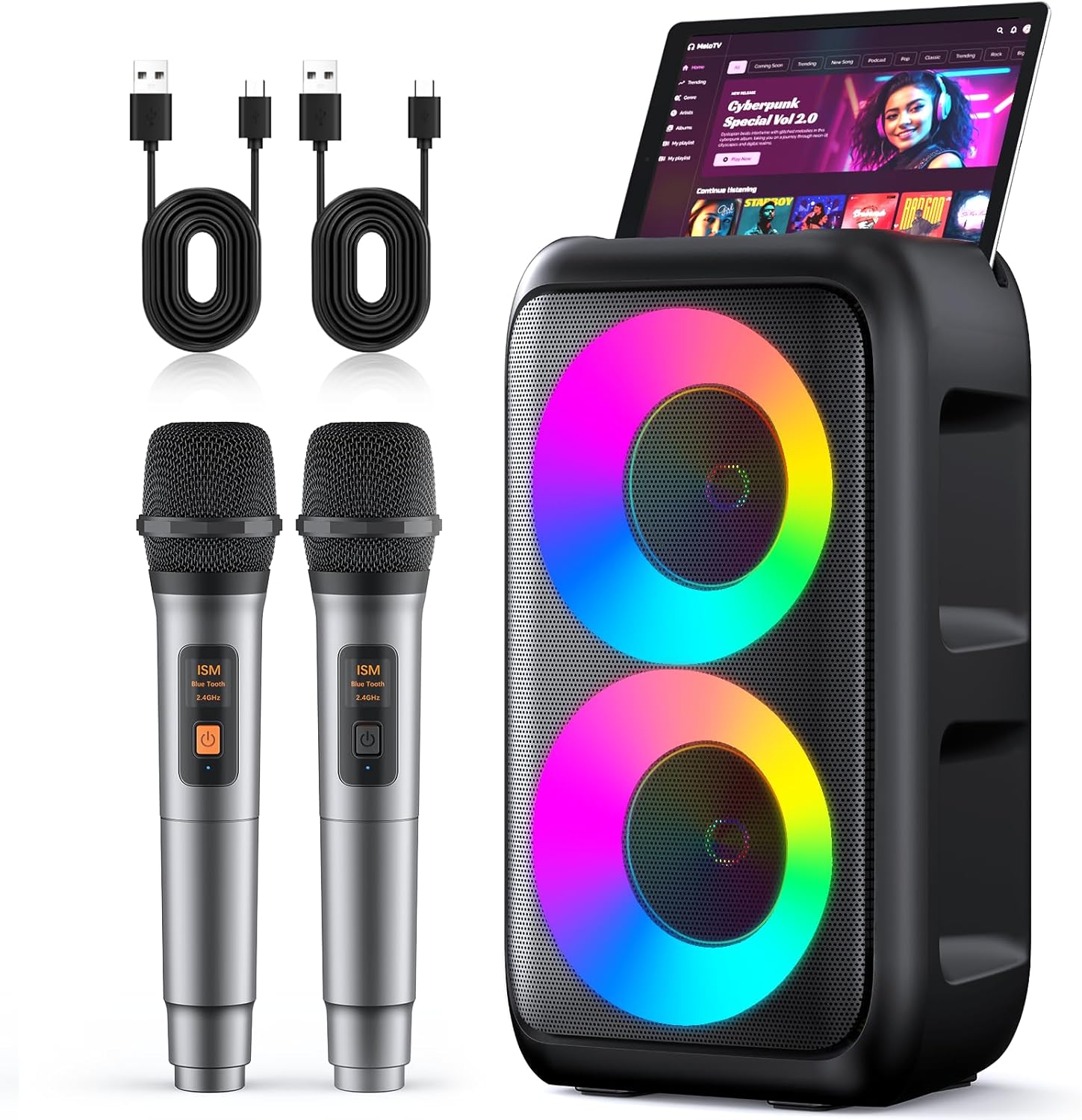
We compared five karaoke machines on Amazon — three screen-based Ikarao systems with built-in song libraries, and two portable Bluetooth party speakers with wireless microphones. Every spec below comes from the manufacturers' listings; where a listing doesn't disclose something, we say so instead of guessing.
WiFi 2.4G/5G, Bluetooth 5.3, USB, HDMI, AUX, guitar input
Bluetooth 5.4, WiFi, HDMI TV out
Bluetooth, Micro TF, USB, AUX-in
Bluetooth 5.3 (50ft), TF card, USB, AUX; TWS pairing
Battery
8 hours (per listing)
Not listed on page
7 hours (per listing)
4–10 hours (varies with volume)
Up to 10 hours; Type-C recharge
Lights
4 DJ lights
Not listed on page
Not listed on page
6 light modes, beat-synced
LED lights sync with music
Best For
All-in-one home karaoke parties with on-screen lyrics
KaraFun subscribers and TV-connected home setups
Portable karaoke with foldable handle
Kids' parties and small-room fun
Outdoor parties and TWS stereo pairing
Top 5 In-Depth Reviews
Detailed analysis of each leading product, including audience fit, limitations, value and purchase information.
#1Ikarao Break X2 Smart Karaoke Machine with Lyrics Display, 32GB Tablet, 2 Wireless Mics, 300W Peak Power, 4 DJ Lights
Product overview
The Break X2 is the flagship of the three Ikarao machines here, built around one idea: everything in one box. The 10.1-inch tablet is the centerpiece — a built-in screen that displays lyrics and rotates 180 degrees, so singers and guests on either side of the room can read along without crowding around one viewing angle. The screen also frees your phone: instead of balancing a handset on a shelf as the lyric source, the machine runs YouTube and Ikarao's karaoke app directly over WiFi, which means the song library is effectively whatever the internet provides. Sound is 300 watts peak with four DJ lights, and the two wireless microphones store inside the speaker body, where they charge automatically — the single most practical anti-clutter detail on this list. The listed eight-hour battery means the machine works for backyard parties without hunting for an outlet. The tradeoff is footprint and price: this is a proper karaoke system, not a toy, and it is the biggest purchase here. If you want the closest thing to a karaoke bar at home, this is the pick.
Who it is for
✓Home karaoke nights where everyone wants to see lyrics on a real screen
✓Families who sing in different languages — a WiFi-based library covers most of them
✓Anyone who hates cable clutter — docked self-charging mics and no phone required
✓Outdoor and indoor parties that need real volume and DJ lighting
✓Buyers who want an all-in-one system instead of a speaker plus accessories
Who should skip it
–Casual singers on a tight budget — the two portable speakers below cost a fraction
–Anyone with very limited storage space — this is the largest unit on the list
–Users who just want background music — a plain Bluetooth speaker does that cheaper
–Buyers who want the longest single-charge runtime among portables
Warranty and value
The Break X2 costs the most on this list, but it bundles a screen, two self-charging microphones, lights, and a serious speaker that would otherwise be bought separately. For households that actually host karaoke regularly, the all-in-one design is the value.
#2Ikarao Karaoke Machine with 10.1" Screen, 280W, 2 Wireless Microphones, KaraFun Prime, HDMI for TV
Product overview
This is the middle Ikarao: the same 10.1-inch touchscreen concept as the flagship in a slightly smaller sound package, with the KaraFun app and a six-month KaraFun Prime membership included. KaraFun matters because it is a dedicated karaoke catalog rather than YouTube's search-and-scroll — songs load as proper karaoke versions with formatted lyrics, which is cleaner for dedicated singers. The sound design is specific rather than just bigger: 2.2-channel output with dual woofers and dual tweeters, with the tweeters angled upward so the sound reaches standing adults instead of their knees. Connectivity is the broadest on this list — WiFi on both bands, Bluetooth 5.3, USB, AUX, a guitar input, and HDMI out for mirroring lyrics to a TV. The two microphones are magnetic and self-charging in the dock, and EQ effects are adjustable. If you already know you will use KaraFun and you have a TV in the party room, this model's feature set maps more precisely to your setup than the flagship's.
Who it is for
✓Dedicated singers who prefer a structured karaoke catalog (KaraFun) over YouTube
✓Homes with a TV in the party room — HDMI mirroring puts lyrics on the big screen
✓Musicians who want the guitar input for practice or accompaniment
✓Buyers who want 2.4G/5G WiFi stability for streaming
✓Anyone who values adjustable mic EQ over maximum wattage
Who should skip it
–Buyers who want the loudest output — the flagship has more peak power
–Users who don't plan to continue KaraFun after the included six-month membership
–Anyone who wants the most compact carry option on this list
–Party hosts who want built-in DJ lighting
Warranty and value
The included six-month KaraFun Prime membership is the value anchor here — a dedicated karaoke catalog with properly formatted songs. If that app subscription is something you would buy anyway, this machine effectively pays part of its own cost.
#3Ikarao Shell S3 Karaoke Machine with Lyrics Display and Professional Karaoke App
Product overview
The Shell S3 is Ikarao's portable take on the karaoke machine: 80 watts, a foldable handle, a seven-hour battery, and a much smaller footprint than its siblings. It keeps the features that make Ikarao interesting — a built-in screen with lyrics display, two wireless microphones with Autotune pitch correction and echo effects, and HDMI out to a TV — but drops the tablet in favor of a leaner display, and adds a remote control, custom key and tempo adjustments, and offline song sync, which is genuinely useful for camping and road trips without WiFi. The DSP chip does real work here: it suppresses feedback howling and noise during loud sections, which is the most common complaint on cheap karaoke speakers. Buyer feedback on this model is more mixed than on its siblings, and it is worth reading recent reviews before buying — the autotune and app experience draw both praise and criticism. As the smallest, most carryable Ikarao, it suits families who want karaoke in the living room and on the campsite from one device.
Who it is for
✓Families who want karaoke at home and on camping trips from one device
✓Singers who want Autotune pitch correction and echo effects built in
✓Users who sing along with custom key and tempo changes
✓Smaller rooms where 80 watts is more than enough
✓Anyone who wants a remote control for hosting from the couch
Who should skip it
–Large party rooms — the larger Ikarao models move much more air
–Buyers who want the strongest review consensus on this list
–Users who don't need portability and prefer maximum screen size
–Anyone who wants built-in party lighting
Warranty and value
As the entry point to Ikarao's ecosystem, the Shell S3 delivers the screen-and-autotune experience at the lowest price of the three. The foldable handle and offline sync add practical value for buyers who will actually carry it.
#4ultramic Karaoke Machine for Kids and Adults, Portable Bluetooth Speaker with 2 Wireless Microphones and LED Lights
Product overview
The ultramic is the opposite end of this list: an 8-watt, one-kilogram party speaker with two wireless microphones, beat-synced disco lights with six modes, and five magic voice effects — Monster, Baby, karaoke mode, and more — that are squarely aimed at making kids laugh. It is the best-selling machine in this guide by sales rank, and the reason is visible in the feature list: it costs what a night of entertainment used to, and it is sized for a child to carry by the built-in shoulder strap. The 360-degree sound fills a bedroom or a small living room, and the four-to-ten-hour battery window depends heavily on volume. USB, TF card, and AUX inputs mean it works without any phone or app at all — load songs onto a card and hand it to a six-year-old. The honest limits: 8 watts will not power a backyard bash or a school hall, and the sound is tuned for fun rather than fidelity. For a kids' party machine or a low-stakes family game night, it is hard to argue with the price and the sales track record.
Who it is for
✓Kids' parties — the light show and voice effects are built for children
✓Bedroom and small-room karaoke, where 8 watts is genuinely enough
✓Parents who want a no-phone-required machine (USB/TF card playback)
✓Budget buyers who want the best-selling unit in the category
✓Gift shopping for birthdays and holidays
Who should skip it
–Outdoor parties or large rooms — 8 watts runs out of headroom quickly
–Adults who care about sound fidelity
–Anyone who wants a lyrics screen
–Users who want the longest battery life on this list
Warranty and value
The ultramic is the cheapest way onto this list and the best-selling for a reason: it trades power and fidelity for lights, voice effects, and a price point that works as a gift. Lifetime technical support is claimed by the listing — a statement to verify, not to bank on.
#5Peski Karaoke Machine, Bluetooth Speaker with 2 Wireless Microphones for Adults and Kids
Product overview
The Peski sits between the kids' toy tier and the full karaoke systems: 15 watts of dual-driver sound in a 3.9-pound body with a ten-hour battery, Bluetooth 5.3 with a 50-foot range, and — the feature that separates it from the ultramic — TWS pairing, which lets you link two units into a stereo pair. Two Peskis cost less than one entry Ikarao and cover a much larger outdoor space in true stereo, a genuinely smart setup for backyard movie nights, tailgates, or a big living room. The LED lights sync to the music rhythm, and both wireless microphones ship with their own rechargeable batteries, which removes the most annoying accessory cost. USB, TF card, and AUX round out the inputs, and Type-C charging is a small modern touch. It will not match the Ikarao systems for screen, song library, or vocal processing — there is no autotune or lyric display here — but for pure outdoor sound and duet singing at this price, it is the strongest portable option on this list.
Who it is for
✓Outdoor parties and tailgates where ten hours of battery matters
✓Buyers who want TWS stereo by pairing two units
✓Duet singers who want both mics with included rechargeable batteries
✓Anyone who wants Bluetooth 5.3 range across a big backyard
✓Households that mostly play music and sing occasionally
Who should skip it
–Singers who want on-screen lyrics — no display here
–Users who want vocal effects like autotune or echo control
–Small kids — this is aimed more at teens and adults
–Anyone who wants the loudest single unit — 15W is portable-tier, not party-hall tier
Warranty and value
At its current discount, the Peski undercuts the ultramic's price-per-watt and adds TWS, a longer battery, and included rechargeable mic batteries. For outdoor use it is the better buy; for a kids' toy box, the ultramic's light show wins.
How to Choose the Best Karaoke Machine for Your Home
The five machines in this guide split into two tiers that serve different rooms. The three Ikarao systems carry their own screens, run real song libraries over WiFi, and are built to be the centerpiece of a party. The ultramic and Peski are portable Bluetooth speakers with wireless microphones and lights — cheaper, lighter, and enough for bedrooms, small living rooms, and outdoor carry. Both tiers are legitimate answers to 'best karaoke machine'; the right one depends on room size, who is singing, and whether you want on-screen lyrics. Every spec below comes from the manufacturers' listings, and where a listing doesn't say something, we say so rather than guess.
Karaoke Machine with Screen vs. Portable Bluetooth Karaoke Speaker
A lyrics screen changes how karaoke actually goes. Without one, singers squint at a phone propped on a table or memorize the words — the setup most people abandon after one night. With a built-in screen, lyrics live where everyone can see them, and the phone stays in your pocket. The Ikarao machines take this further: the screens run YouTube and karaoke apps over WiFi, so the song library is effectively unlimited and constantly updated. Portable speakers skip the screen to hit a lower price and smaller size, relying on your phone for lyrics. If the machine is for kids under ten or background music at a barbecue, the screen doesn't matter much; if adults are actually singing, it does.
How Many Watts Does a Karaoke Machine Need?
Wattage is the best rough proxy for how big a space a machine can fill, and the numbers on this list tell the story: 8 watts fills a bedroom or a small kitchen; 15 watts handles a living room or a patio at conversation-plus volume; 80 watts covers a large living room comfortably; and the 280W and 300W peak systems can pressurize a backyard party or a small hall. Peak ratings flatter — continuous output is lower — but the relative gaps are real: the flagship Ikarao moves roughly twenty times the sound energy of the kids' unit. Rule of thumb: pick wattage for the largest room you'll actually host in, not the party you imagine hosting someday.
Wireless Microphones: Self-Charging Docks, Autotune, and Voice Effects
All five machines ship with two wireless microphones, but the charging story separates them. The Ikarao models dock the mics inside the speaker body where they charge automatically — the design that means you never discover dead microphones at party time. The Peski includes rechargeable batteries for both mics, and the ultramic charges its pair separately. Vocal processing is the second differentiator: the Shell S3 carries Autotune pitch correction and echo effects, which forgive flat notes and make casual singers sound better; the ultramic's five magic voice effects entertain kids without pretending to be serious audio engineering. If the singers are adults who care how they sound, Autotune matters; if they are eight years old, Monster voice wins.
Karaoke Song Libraries: YouTube, KaraFun, and Offline Options
Where the songs come from matters more than the speaker specs for regular use. The Ikarao machines stream over WiFi — the flagship runs YouTube plus Ikarao's own app, and the two KaraFun-equipped models include a six-month KaraFun Prime membership with a catalog of properly formatted karaoke tracks and new songs added monthly. The Shell S3 adds offline sync for camping and road trips. The portable pair take the opposite approach: USB drives, TF cards, and AUX inputs play whatever you already own, with no subscription and no WiFi required. One honest note on memberships: after the included KaraFun trial window, the catalog becomes a subscription decision — factor that in if ongoing cost matters.
Portable Karaoke Machines: Battery Life and Carry Design
If the machine leaves the house, battery and carry design decide how often it actually goes. The ultramic weighs about a kilogram with a shoulder strap and runs four to ten hours depending on volume. The Peski stretches to ten hours with a 3.9-pound body and Type-C charging. On the Ikarao side, the Shell S3 is the carryable one — foldable handle, seven-hour battery — while the flagship manages eight hours despite its much bigger output. The honest pattern: bigger sound burns battery faster, and every listed runtime is the manufacturer's claim measured under its own conditions. For beach days and campsites, the two portables are the natural picks; for a backyard three houses from an outlet, any of them work.
Karaoke Machine for Kids vs. Adults: Which One to Buy
The kids-versus-adults question is mostly a watts-and-features question in disguise. Kids want lights, funny voices, and one-button operation — the ultramic is engineered exactly for that, with six light modes, magic voice effects, and card-based playback that works without a phone. Adults who actually sing want lyrics, real volume, and vocal processing: a screen-based Ikarao with autotune or EQ. Families spanning both should buy for the adults and let the kids borrow it — a screen system entertains children too, but an 8-watt toy cannot grow with the family. The Peski splits the middle for teens and mixed crowds.
Frequently Asked Questions
The Ikarao Break X2 leads this guide as the all-in-one flagship: built-in 10.1-inch lyrics screen, two self-charging wireless microphones, 300W peak output, and a WiFi song library. For a budget pick, the ultramic is the best-selling portable unit, and the Peski adds TWS pairing and a ten-hour battery for outdoor use.
If adults will sing regularly, yes — a lyrics screen is what keeps karaoke nights going past the first week. The screen replaces the phone-propped-on-a-table setup and works for everyone in the room at once. If the machine is for kids under ten or background music at parties, a screenless portable speaker with microphones is usually enough.
Match watts to the largest room you'll actually use: 8–15W for bedrooms and small living rooms, 80W for a large living room, and 250W+ for backyards and halls. Peak ratings flatter every speaker, but the gaps between tiers on this list are real — a 300W system moves far more air than an 8W toy.
Two of the Ikarao models — the 280W KaraFun version and the Shell S3 — have HDMI output for mirroring lyrics to a TV. The flagship uses its own rotating screen instead. The portable speakers have no TV output; you'd pair a phone with your TV separately if you want bigger lyrics.
It depends on the machine. The Ikarao systems stream over WiFi from YouTube and karaoke apps, and the two KaraFun models include a six-month KaraFun Prime membership with a dedicated catalog. The portable units play songs you supply via USB drive, TF card, or AUX — no WiFi or subscription required.
Three approaches appear on this list. The Ikarao machines dock the microphones inside the speaker where they self-charge, which is the most convenient. The Peski microphones run on included rechargeable batteries, and the ultramic charges its pair separately. Check the listing details if charging method matters to you.
Claimed runtimes here range from four to ten hours, and the honest truth is that actual playtime depends heavily on volume and content — loud playback with heavy bass drains faster. The Peski claims up to ten hours, the Shell S3 seven, the flagship Ikarao eight, and the ultramic four to ten. Treat these as manufacturer estimates.
For young kids, yes — the ultramic is designed for exactly that with disco lights, magic voice effects, and card-based playback that doesn't need a phone. For teens and adults, a screen-based system like the Ikarao models is a stronger gift because it grows with their interest. Match the wattage and features to the recipient's age.
Get weekly top picks
Data-ranked products delivered to your inbox every week. Skip the research, get the winners.
No spam ever. Unsubscribe anytime. We respect your inbox.