Best Laser Levels 2026
Compare the best green laser levels for construction, framing, flooring, tile, ceiling installation, outdoor grading, and home projects. We assess beam layout, accuracy, visibility, receiver compatibility, mounting, battery life, durability, and included accessories.
We may earn a commission from links on this page.

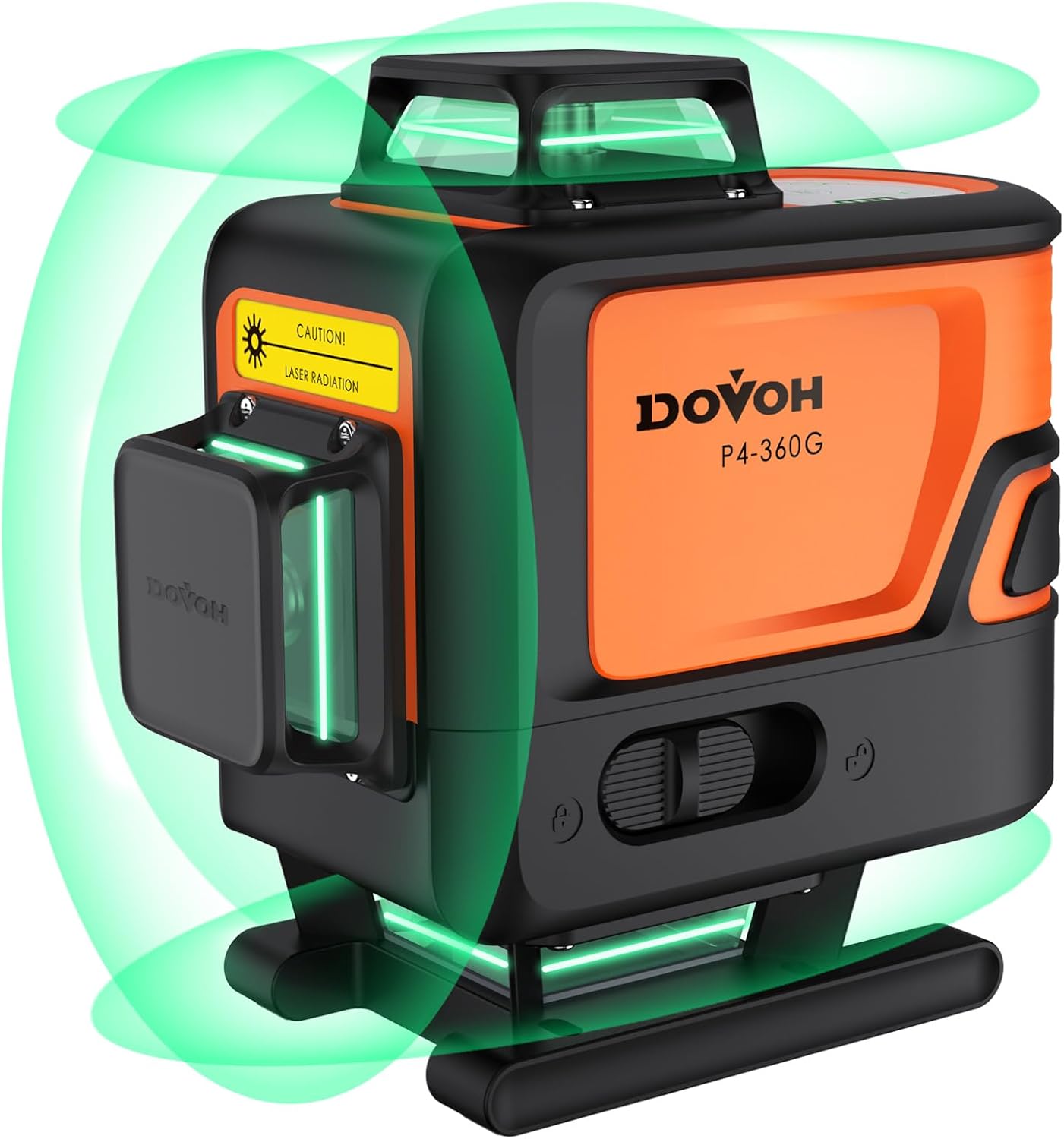

Top Picks Compared
1. DOVOH H3-360G-KIT Outdoor 360 Laser Level with Receiver DOVOH | 2. DEWALT DW0811LG 12V MAX Green 2x360 Laser Level DEWALT | 3. DOVOH Y4-360G-KIT 4D Laser Level with Tripod DOVOH | 4. DOVOH K4-360G 4x360 Self-Leveling Laser Level DOVOH | 5. Klein Tools 93PLL 3x360 Green Laser Level KLEIN | |
|---|---|---|---|---|---|
| Our Score | 9.8 | 9.7 | 9.6 | 9.5 | 9.4 |
| Deal | — | — | — | — | — |
| Beam Layout | 1×360° | 2×360° | 4×360° (2H + 2V) | 4×360° | 3×360° (X/Y/Z) |
| Laser Color | Green | Green | Green | Green | Green |
| Working Range | 400 ft (with receiver) | 50 ft (165 ft w/ detector) | Indoor + tripod to 60.2 in | 197 ft (with receiver) | Indoor |
| Accuracy | Self-leveling | ±1/8 in at 30 ft | Self-level ±4°, slope mode | Self-leveling | ±1/8 in at 33 ft |
| Durability (IP) | Double shockproof core | IP65 | Overmold housing | Overmold rubber | IP54 |
| Battery | 2× 2600mAh rechargeable | 12V MAX (DEWALT) | 2× 2600mAh + USB | 2× 7.4V 2600mAh | Rechargeable, 9+ hrs |
| Best For | Outdoor & grading | Premium 2-plane pro | 4D layout + tripod kit | Ceiling-to-floor coverage | Plumb points & alignment |

Laser Level Buying Guide
The best laser level is the one whose beam layout, accuracy, range, visibility, and mounting system match the work rather than simply offering the greatest number of lines. A homeowner hanging cabinets may need a clear horizontal reference and simple magnetic mount, while a flooring installer, framer, or ceiling contractor may benefit from multiple 360-degree planes. Compare the complete specification for the exact model, including tolerance at a stated distance, self-leveling range, receiver compatibility, laser class, environmental protection, battery system, and the accessories included in the kit.
Choosing 2x360, 3x360, or 4x360 Laser Levels
A 2x360 laser level normally projects one horizontal and one vertical plane, which is enough for many framing, cabinet, trim, and room-layout jobs. A 3x360 laser level adds a second vertical plane, allowing perpendicular wall lines and squaring from one setup. A 4x360 or 4D laser level typically adds a second horizontal plane positioned closer to the floor or ceiling. That lower plane can speed tile and floor layout, but extra diodes add cost, power demand, and controls. Choose the smallest configuration that covers the reference planes you repeatedly use.
Green Beam Visibility and Outdoor Laser Level Use
Green laser levels are generally easier for the human eye to see than comparable red beams indoors, but no visible line should be expected to remain clear across long distances in direct sunlight. Outdoor laser level work normally relies on pulse mode and a compatible receiver rather than visual beam brightness. Confirm the receiver frequency, stated working diameter or radius, and whether the detector is included. A 400-foot receiver range does not mean the naked eye can see the beam at 400 feet, and glasses or a target plate do not replace a detector in strong daylight.
Laser Level Accuracy, Calibration, and Working Distance
Accuracy should always be read with its test distance, such as ±1/8 inch at 33 feet. Small angular errors become larger over a longer run, so a specification without distance is incomplete. Check a new construction laser level against a known reference before critical work and repeat the test after a drop, hard impact, transport, or unexplained layout error. Self-leveling does not correct an out-of-calibration instrument; it only positions the internal pendulum within its designed range. Professional calibration or manufacturer service may be necessary when verification fails.
Self-Leveling Range and Manual Slope Mode
Most self-leveling laser levels in this comparison can correct within roughly ±4 degrees. If the base is outside that range, the line usually flashes or the tool beeps, telling the user to reposition it. Manual mode locks the pendulum so angled references can be projected for stairs, rails, tile patterns, or decorative layouts. A locked angled beam is not gravity-level, so clearly distinguish slope work from level and plumb measurements. Lock the pendulum for transport when the manual requires it to protect the mechanism.
Mounting Brackets, Tripods, and Fine Adjustment
A stable mount matters as much as beam brightness. Magnetic brackets attach quickly to steel track, but verify magnet strength, adjustment travel, and the mounting thread before relying on them overhead. A laser level with tripod offers flexible height in open rooms and outdoor areas; check maximum extension, load rating, foot stability, and whether the head permits fine rotation. For floor and ceiling work, compare how close the top and bottom horizontal planes sit to the surface, because housing clearance determines how much measuring and line transfer is required.
Rechargeable Batteries and Jobsite Runtime
Multiple 360-degree green beams can consume substantial power, especially when all planes are active. Dual-battery kits reduce downtime, while removable packs let one battery charge during use. Direct USB operation can keep some laser levels running when both packs are empty, but it may limit weather resistance or create a cable hazard. Compare runtime under the beam configuration you actually use rather than the most favorable single-plane claim, and confirm that replacement batteries and chargers remain available.
Dust, Water, Shock, and Construction Durability
IP ratings describe tested resistance to dust and water ingress, not protection against every jobsite hazard. IP54 provides a different level of protection from IP65, and neither makes a laser level safe for immersion. Rubber overmolding and cushioned core assemblies can reduce damage from normal bumps, but precision instruments should still be transported in their case and protected from drops, extreme temperatures, vibration, and wet storage. Inspect windows and mounts for damage and verify calibration whenever the tool receives a significant impact.
Laser Safety and Responsible Setup
Read the laser class and safety instructions for the exact model. Never stare into a beam, aim it toward another person's eyes, view it through optical instruments, or place it where traffic can encounter it. Green glasses supplied with some kits improve line contrast but are not automatically protective laser eyewear. Secure the laser level and tripod against tipping, control the work area, and follow applicable jobsite rules. Turn the tool off before repositioning accessories and keep it away from children.
FAQ
A 3x360 model adds a second vertical plane, making square room layout, wall alignment, and plumb transfer easier from one position. A 2x360 laser level may be simpler and fully adequate for horizontal leveling and one vertical reference. The better choice depends on the planes the work requires.
Visibility drops sharply in bright sunlight regardless of beam color. For reliable outdoor work, use pulse mode with a receiver that is compatible with the laser's frequency. The advertised detector range is not the same as the distance at which the unaided eye can see the line.
Follow the manufacturer's field-check procedure on a stable surface using measured distances and clearly marked reference points. Test horizontal level, vertical plumb, and squareness as applicable. If error exceeds the stated tolerance, stop using the instrument for critical layout and contact the manufacturer or a calibration service.
It means the internal pendulum can establish level when the tool body is positioned within about four degrees of level. Outside that range, most units flash or beep. It does not mean the projected line can be four degrees off and still be considered level.
Not always. Magnetic brackets work well on steel framing, and some mounts clamp to boards or hang from fasteners. A tripod is useful when no suitable surface exists or when beam height changes frequently. Match the tripod thread and load capacity to the laser.
Not necessarily. Many included glasses are visibility-enhancement glasses that improve contrast, not certified eye protection for the laser wavelength and power. Never look into the beam and follow the exact model's safety instructions and workplace requirements.
Get weekly top picks
Data-ranked products delivered to your inbox every week. Skip the research, get the winners.
No spam ever. Unsubscribe anytime. We respect your inbox.