Best Luggage Sets
Discover the best luggage sets for vacations, business travel, and family trips. Our top picks combine lightweight materials, durable shells, spinner wheels, smart storage, and reliable performance.
We may earn a commission from links on this page.


Top Picks Compared
1. Coolife 3-Piece Hard Shell Luggage Set COOLIFE | 2. Coolife 3-Piece Hardshell Spinner Luggage COOLIFE | 3. 5-Piece ABS Luggage Set with TSA Lock 5-PIECE | 4. LIGHT FLIGHT 3-Piece Spinner Luggage Set LIGHT | 5. 6-Piece ABS+PC Luggage Set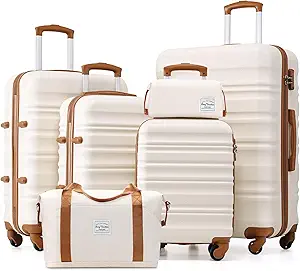 6-PIECE | |
|---|---|---|---|---|---|
| Our Score | 9.8 | 9.6 | 9.5 | 9.4 | 9.3 |
| Deal | — | — | — | — | — |
| Pieces | 3-piece | 3-piece (20/24/28") | 5-piece | 3-piece | 6-piece |
| Shell Material | ABS + PC | 100% ABS | ABS | ABS hard-shell | ABS + PC |
| Wheels | Spinner | 360° spinner | Spinner | Spinner | 4 quiet wheels |
| Expandable | No | No | No | Carry-on +25% | No |
| TSA Lock | Yes + 2-yr warranty | — | Yes | — | — |
| Best For | Overall pick | 3-piece value | Set with duffel bag | Lightweight expandable | Large multi-piece set |

Luggage Set Buying Guide
A luggage set can provide coordinated sizes for short trips, checked baggage, and family travel, but the number of pieces alone does not determine value. The best set should match the trips you take most often, comply with the airlines you use, remain manageable when fully packed, and withstand repeated handling. Compare the usable suitcase sizes first, then evaluate shell material, wheels, handles, zippers, locks, interior organization, expansion, and warranty coverage.
Choose Sizes Around Your Travel Habits
A typical three-piece luggage set includes a carry-on and two checked suitcases. Larger five- or six-piece sets may add a travel bag, cosmetic case, or packing accessory. Confirm whether the listed dimensions include wheels and handles, because airlines measure the complete exterior. A large checked case offers more volume but can exceed airline weight limits before it is full. Couples and families may benefit more from several medium cases than one oversized suitcase because weight is easier to distribute.
Verify Carry-On Compatibility
There is no universal carry-on size. Airline limits vary by carrier, route, fare, and aircraft, and an expandable suitcase may no longer qualify after its expansion zipper is opened. Check the airline's current dimensions and weight allowance before each trip. Measure the suitcase at its widest and tallest points, including protruding wheels and handles. A bag described as airline approved should still be compared with the rules for your exact booking.
Hard-Shell Materials
ABS is common in affordable hard-shell luggage because it is light and easy to form, though it may show wear or crack under severe impact. Polycarbonate generally flexes more and can provide stronger impact resistance, often at a higher price. ABS and PC composites aim to balance weight, cost, and durability. Surface texture can hide scuffs, but no checked suitcase remains completely scratch-free. PU leather prioritizes appearance and easy wiping but should be judged separately for abrasion resistance, frame support, and long-term care.
Wheels and Handles Matter Every Trip
Four-wheel spinners move easily beside the traveler and turn in tight spaces, while their exposed wheels absorb impacts during baggage handling. Look for smooth rotation, secure wheel housings, and minimal wobble. A telescoping handle should lock at a comfortable height without excessive twisting. Test top and side carry handles as well, because stairs, curbs, car trunks, and baggage scales often require lifting a fully loaded case.
Zippers, Locks, and Security
Zippers are frequent stress points, especially when an expandable suitcase is overpacked. Check zipper size, stitching, pulls, and how smoothly the track closes around corners. A TSA-recognized combination lock can allow authorized inspection without cutting the lock, but it does not make luggage theft-proof. Keep valuables, medication, documents, electronics, and essential items in a personal item or carry-on rather than checked baggage.
Interior Organization and Expansion
Dividers, compression straps, zippered panels, and mesh pockets keep contents separated and reduce shifting. A clamshell case opens into two halves and needs enough floor or bed space to pack. Expansion adds useful volume for souvenirs or irregular loads, but it also changes dimensions, balance, and total weight. Packing cubes can provide more flexible organization than permanently divided compartments, especially when several travelers share a set.
Nested Storage and Set Weight
Many luggage sets nest the smaller pieces inside the largest case, reducing closet space between trips. Confirm that all pieces actually nest and consider whether accessories must be removed first. Empty weight matters because every pound of suitcase reduces the payload available under an airline limit. Compare each piece individually rather than relying on one total set weight, and make sure the largest suitcase is still comfortable to lift when packed.
Warranty and Replaceable Parts
Read what the warranty covers, how long it lasts, and whether airline damage is excluded. Wheels, telescoping handles, zipper pulls, and locks are common failure points, so available replacement parts can extend the useful life of a set. Photograph checked luggage before departure and report airline damage promptly under the carrier's procedure. Clean the shell and wheels after travel, dry the interior fully, and store cases without heavy items pressing on them.
FAQ
A carry-on plus medium and large checked cases covers many common trips. The best combination depends on airline rules, trip length, and how many people share the set. Several medium cases can be easier to keep under weight limits than one very large suitcase.
ABS is generally affordable and lightweight, while polycarbonate often provides greater flexibility and impact resistance. Composite shells combine materials to balance cost, weight, and strength. Construction quality, corners, zippers, wheels, and handles are also important, so material should not be the only deciding factor.
No. The stated size may not include wheels and handles, and airline limits vary. Compare the suitcase's complete exterior dimensions and weight with the current rules for your airline, route, fare, and aircraft. Expansion can also make an otherwise compliant bag too large.
They are not generally required, but a TSA-recognized lock can allow authorized inspection without destroying the lock. It provides limited deterrence rather than complete security. Important valuables and documents should remain with you instead of being packed in checked luggage.
A set can offer a lower price per piece and coordinated nested storage, but it is only good value if you will use the included sizes and accessories. Buying individual cases may be better when you need specific dimensions, weights, materials, or replacement options.
Get weekly top picks
Data-ranked products delivered to your inbox every week. Skip the research, get the winners.
No spam ever. Unsubscribe anytime. We respect your inbox.