We compared four resin 3D printers and one high-speed FDM machine across resolution, build volume, leveling, and smart features. Every spec below comes from the manufacturers' listings; where a listing doesn't disclose something, we say so instead of guessing.
AI print monitoring, resin level & residue detection, Wave Release
LighTurbo matrix light, power-loss resume; no app support
3s nozzle change, 35s warm-up, Flash Studio app monitoring
Smart tank heating, auto resin feeding, mechanical sensors, Wi-Fi cluster, HDR camera
AFU resin management, RFID, 92 light zones, top-down optical system
Best For
Detail-focused hobbyists and industrial-grade resins
Beginners and small-footprint daily printing
Fast prototyping and FDM materials
Large builds and batch printing
Professional detail with hands-off resin management
Top 5 In-Depth Reviews
Detailed analysis of each leading product, including audience fit, limitations, value and purchase information.
#1ANYCUBIC Photon P1 14K Resin 3D Printer with Auto-Leveling
Product overview
The Photon P1 is ANYCUBIC's flagship play for detail. The 10.1-inch 14K mono LCD resolves at 13,312 × 5,120 pixels with XY pixels down to 16.8 × 24.8 micrometers, and the listing claims a minimum printable aperture of 0.3 millimeters — numbers that put it in the top tier of consumer resin printers for fine detail like miniatures, jewelry masters, and dental-style models. The motion system backs up the screen: ball screws and precision guide rails instead of cheaper leadscrew-plus-bushing designs, which is what keeps tall prints stable as the plate rises. Smart Leveling 3.0 removes the leveling chore entirely — the machine is factory-calibrated, self-checks before each print, and reports pressure feedback from all four corners. The AI monitoring system verifies two classic failure points (build plate installation and bottom-layer separation) and watches resin level and vat residue. The headline material feature is viscosity: the P1 is rated for resins up to 8,000 cps, roughly forty times standard resin per the listing, which opens the door to industrial and engineering resins that cheaper machines cannot feed. This is a new model with a short track record, so early-adopter caution applies — but on paper and in spec, it is the most capable printer on this list.
Who it is for
✓Miniature painters and jewelry makers who want the sharpest possible detail
✓Users who want zero manual leveling — factory-calibrated with self-checks
✓Advanced creators printing industrial or high-viscosity resins
✓Anyone who wants AI monitoring to catch failed prints early
✓Buyers who want the newest screen technology rather than an older proven design
Who should skip it
–Buyers who prefer a model with a long, established review history
–Large-format builders — the ELEGOO Jupiter 2 offers a much bigger build volume
–Anyone who wants FDM materials like PLA or PETG — the FLASHFORGE covers that
–Beginners on a tight budget — the Photon Mono 4 below is the gentler entry point
Warranty and value
The P1's value case is its feature density: 14K resolution, auto leveling, AI monitoring, and industrial-resin support in one machine. The offsetting risk is that it is a new model — the specs are exceptional, and the track record is still being written.
#2ANYCUBIC Photon Mono 4, Resin 3D Printer with 7" 10K Mono LCD Screen
Product overview
The Photon Mono 4 is the sensible entry point of this list: a 7-inch 10K mono LCD with 9024 × 5120 resolution and 17 × 17 micrometer pixels, which the listing frames as a 105% precision jump over the previous Mono 2 generation. For miniatures, prototypes, and everyday resin prints, that resolution is well past the point of diminishing returns for most users — you get crisp detail without paying for the flagship tier. The LighTurbo matrix light source is the quality feature that matters day to day: even, balanced exposure across the whole screen means fewer layer lines and smoother surfaces. The 153.4 × 87 × 165 mm build volume is modest but covers the vast majority of hobby prints, and the laser-engraved platform improves first-layer adhesion while keeping removal simple. Leveling is a one-time job with the 4-point method, and power-loss resume means a brownout doesn't waste a vat of resin. One honest note the listing itself makes: the ANYCUBIC app does not support this model, so everything runs from the printer's own controls — which is fine for beginners, but don't buy it expecting remote monitoring.
Who it is for
✓First-time resin printer owners who want a simple, proven entry point
✓Miniature and model makers who don't need a huge build plate
✓Users who want one-time leveling rather than ongoing adjustments
✓Anyone printing in a small workspace — compact footprint
✓Buyers who value the strongest review base among the resin options here
Who should skip it
–Users who want app or remote control — the listing states the app is unsupported
–Large-format builders — the build volume is the smallest practical tier here
–Industrial-resin users — the Photon P1 is rated for far higher viscosity
–Anyone wanting the sharpest available pixels — the 14K and 16K machines go finer
Warranty and value
The Mono 4 is the lowest-cost resin machine on this list and the one with the most established buyer feedback. For beginners, buying the proven model at the entry price is almost always the right first move — upgrade later once you know what you actually need.
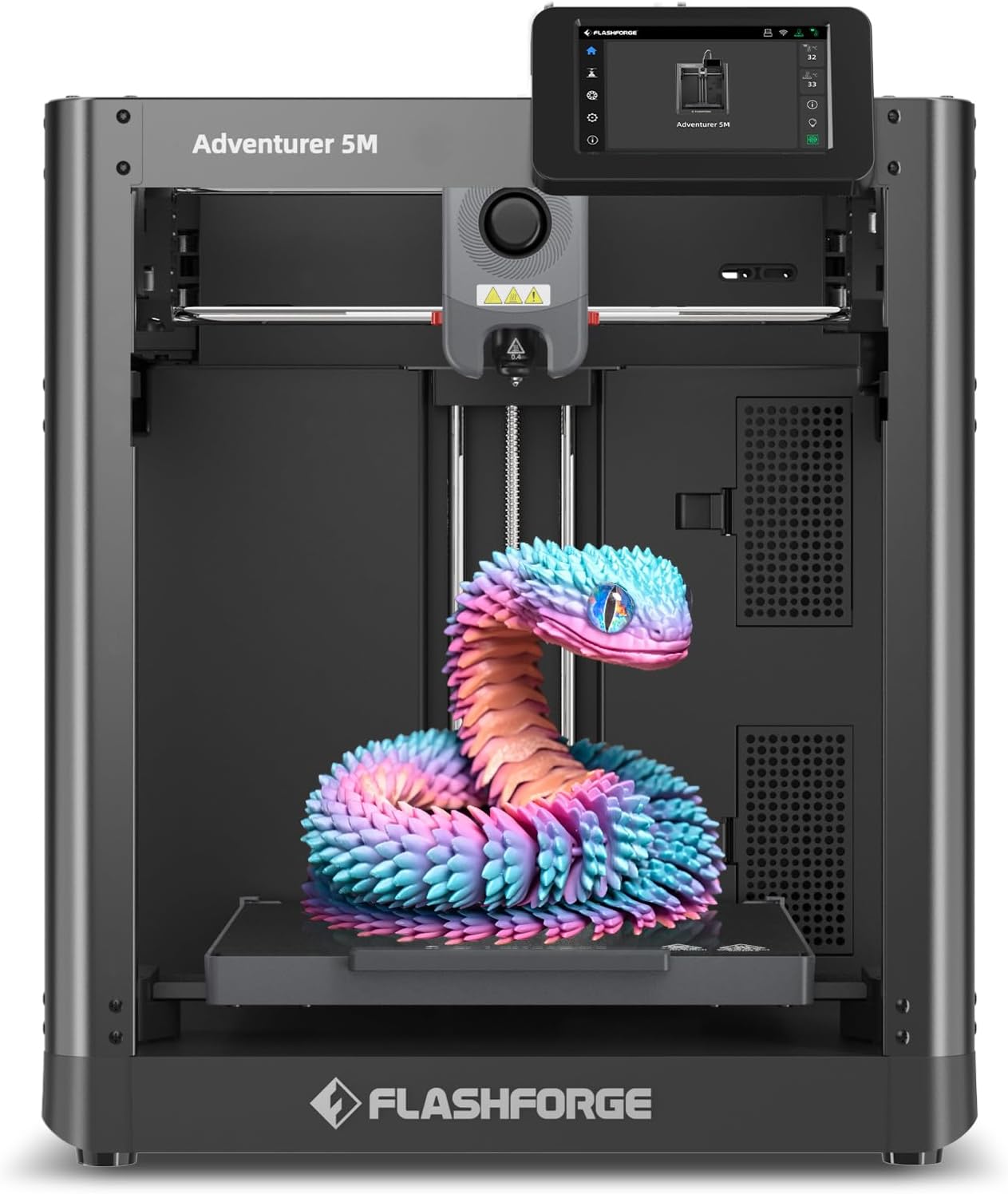
#3FLASHFORGE Adventurer 5M 3D Printer, 600mm/s High Speed, Auto Leveling
Product overview
The Adventurer 5M is the filament outlier on a list dominated by resin, and it earns its place on purpose: for functional parts, quick prototypes, and everyday materials like PLA and PETG, FDM is still the more practical technology. The CoreXY frame with 600mm/s travel speed and 20,000mm/s² acceleration puts it in the modern high-speed class — prints that took a day on older bed-slingers finish in hours. The speed is backed by the hotend rather than just marketing: a 280°C direct drive extruder, a high-flow 32mm³/s nozzle, and a 35-second warm-up to 200°C, so the machine is actually printing while others are still heating. Nozzle swaps take a claimed three seconds and accept sizes from 0.25mm for fine detail up to 0.8mm for fast draft work. Fully automatic bed leveling and the dual-sided PEI platform remove the two classic first-printer frustrations, and the Flash Studio app covers remote monitoring and status alerts. The honest framing: this machine cannot match the four resin printers for surface detail on miniatures, and it doesn't try to. What it does is turn filament printing into a one-click, high-speed workflow — the best fit for mechanical parts, brackets, toys, and anything that needs to survive being handled.
Who it is for
✓Functional parts and prototypes in PLA, PETG, and similar filaments
✓Beginners who want one-click printing with automatic leveling
✓Users who need speed — 600mm/s class printing
✓Anyone who wants app-based remote monitoring
✓Households without a ventilated workspace for resin printing
Who should skip it
–Miniature painters — resin resolution is an order of magnitude finer
–Users who want a large-format machine — 220mm cube is standard, not big
–Anyone expecting resin-grade surface finish on curved parts
–Buyers who want the quietest possible machine — fast FDM prints are audible
Warranty and value
At its current discount, the Adventurer 5M prices like a mid-range machine while delivering the high-speed CoreXY platform that used to cost considerably more. If your prints are functional rather than decorative, this is the strongest FDM value on the list.
#4ELEGOO Jupiter 2 Resin 3D Printer, 16K Large MSLA, Auto-Leveling, Smart Tank Heating
Product overview
The Jupiter 2 is the big-picture machine on this list — literally. A 302.4 × 161.98 × 300 mm build volume dwarfs the desktop printers here, and the listing claims it is two and a half times the volume of ELEGOO's own Saturn 4. That means full-size helmets, statues, and cosplay parts print in one piece instead of being sliced into assemblies, or an entire squad of miniatures in a single overnight job. The 16K screen at 15120 × 6230 with 20 × 26 micrometer pixels keeps detail from getting diluted by the bigger format — a large printer with coarse pixels would be pointless, and this one avoids that trap. The automation story is the other headline: multi-point auto leveling, a heated tank that holds resin at a precise 30°C (consistent viscosity means consistent exposure), and automated resin feeding so a long print doesn't fail at hour twenty for lack of material. The mechanical sensors add three alarm types — resin shortage, residue, and leveling failure — and the dual-band Wi-Fi with cluster management is aimed at print farms running several machines. The double-door enclosure and drip tray show the designers expect serious use. This is the most complex machine on the list, with a matching learning curve — beginners should look at the Mono 4 first, and only step up when a project actually demands the volume.
Who it is for
✓Cosplay and prop makers who need full-size single-piece prints
✓Batch printing — an entire miniature army in one job
✓Workshops that want automated resin feeding and heated tanks
✓Print farms that can use Wi-Fi cluster management
✓Users who want camera monitoring and time-lapse recording built in
Who should skip it
–Beginners — the feature set and enclosure size are overkill for a first printer
–Small desks — the double-door enclosure needs real floor or bench space
–Budget buyers — the volume and automation carry a real price
–Users who want a compact machine they can store away between prints
Warranty and value
The Jupiter 2's value is in capacity per dollar: machines with this build volume and automation level typically cost substantially more. For hobbyists who outgrow desktop resin within a year, skipping straight to the Jupiter 2 is often cheaper than upgrading twice.
The Halot-X1 is Creality's automation-heavy answer to the resin printer. The screen is a 10.1-inch 16K mono LCD at 15120 × 6230 with 14 × 19 micrometer pixels — the finest pixel pitch on this list — and the listing claims print speeds up to 170 mm/h, roughly three times its own earlier generation. The structural idea is unusual and clever: the optical module and resin vat move while the build plate stays fixed, which the listing argues gives superior stability and 0.01 mm Z-axis positioning precision, and which eliminates leveling entirely — there is nothing to level. The AFU Resin Management System is the differentiator: it heats resin to 30–45°C in about three minutes, reads resin parameters automatically via RFID tags, detects resin levels with lasers, and supports feeding and recycling leftover resin, with real-time weight monitoring to confirm there is enough material for the job. The 92 independent light zones expose only where the model is, which reduces overexposure and extends screen life. This is a brand-new listing with very little buyer feedback so far — the features are genuinely advanced, but the track record is not yet written. Treat it as a professional-grade bet on automation.
Who it is for
✓Users who never want to level a build plate again
✓Professionals who want the finest pixel pitch on this list
✓Anyone who wants resin heating and RFID parameter loading automated
✓High-detail work where the 92-zone exposure control protects screen life
✓Buyers comfortable adopting a new platform early
Who should skip it
–Buyers who want proven reliability — this listing is brand new
–Large-format builders — the Jupiter 2 offers a much taller build volume
–Beginners on a budget — the automation carries a price premium
–Users who want to stick with a large community of existing owners
Warranty and value
The Halot-X1's value is automation density: no-leveling design, resin management, and the finest pixels here in one unit. The price of that is early-adopter risk — the capabilities are real, the community is not there yet.
The five machines in this guide span two printing technologies with one shared promise: turning digital models into physical parts with minimal tinkering. Four are resin (MSLA) printers — the technology for fine detail, miniatures, and smooth surfaces — and one is a high-speed FDM filament machine that belongs on the list because functional parts are a different job than decorative ones. Every spec below comes from the manufacturers' listings, and where a listing doesn't disclose something, we say so instead of guessing.
Resin vs FDM: Why Both Are on This List
Resin and FDM printers solve different problems, and the divide comes down to detail versus durability. A resin printer cures liquid photopolymer layer by layer with UV light, which is why the ANYCUBIC, ELEGOO, and Creality machines here resolve pixels measured in micrometers — the surface finish comes out smooth enough to paint directly. The tradeoff is resin handling: liquid resin is sticky, smelly, and needs washing and curing after every print. An FDM printer like the FLASHFORGE Adventurer 5M melts plastic filament instead, which is cheaper to run, stronger in functional parts, and needs no post-processing — but layer lines are visible and fine detail tops out far below resin. The honest rule: miniatures, jewelry, and display models favor resin; brackets, tools, and toys favor FDM.
Screen Resolution: What 10K, 14K, and 16K Actually Mean
Resin printer marketing has a resolution arms race, and the numbers are worth decoding. What matters is not the 'K' label but the XY pixel size: the Photon Mono 4's 10K screen has 17-micrometer pixels, the Photon P1's 14K screen drops to 16.8 × 24.8 micrometers, the Jupiter 2's 16K lands at 20 × 26 micrometers across a much larger area, and the Halot-X1's 16K reaches 14 × 19 micrometers — the finest pitch on this list. Below roughly 20 micrometers, the difference is visible mainly in the smallest details: chain mail, text engravings, and hair-thin features. For most prints, a 10K machine is already past the point where resolution is the limiting factor — build volume, reliability, and resin management matter more.
Resin 3D Printers for Beginners: Where to Start
The best resin 3D printer for a beginner is the one with the fewest things to get wrong, and the Photon Mono 4 is built around exactly that idea: one-time 4-point leveling, a laser-engraved platform that grips the first layer, power-loss resume, and a modest 153 × 87 × 165 mm build volume that keeps every print manageable. Its 10K resolution is genuinely good enough that most beginners will never notice the difference to a 14K or 16K screen. Start there, learn the wash-and-cure routine on a small machine, and upgrade only when a specific project demands more volume or finer pixels.
Auto Leveling and Smart Monitoring: The Features That Save Failed Prints
Failed prints in resin printing are usually leveling failures or empty vats, and this generation of machines attacks both. The Photon P1's Smart Leveling 3.0 is factory-calibrated, self-checks before every print, and reports pressure from all four corners; the Jupiter 2 adds multi-point auto leveling with real-time data feedback; and the Halot-X1 sidesteps the problem entirely with a fixed build plate — there is nothing to level. On the monitoring side, the P1's AI inspection verifies plate installation and bottom-layer separation, the Jupiter 2's mechanical sensors alarm on resin shortage, residue, and leveling failures, and both large machines watch the resin supply so a long print doesn't die at hour twenty. If you print overnight, these are the features that decide whether you wake up to a finished model or a cured brick.
Resin 3D Printer Safety: What Every New Owner Should Know
Resin printing is safe when handled properly, and the basics are non-negotiable: liquid resin is a chemical that should not touch skin or eyes, so nitrile gloves and eye protection are standard practice for every session. Work in a ventilated space — the smell varies by resin brand but the fumes are not something to breathe for hours — and keep the machine away from food prep areas. Uncured prints need washing (usually in isopropyl alcohol or a water-washable resin) and then curing under UV light before handling; the wash-and-cure step is part of every resin print, not an optional extra. Enclosures like the Jupiter 2's double-door design help, but they do not replace gloves and ventilation. If a workspace cannot offer ventilation, an FDM machine like the Adventurer 5M is the safer fit.
Large-Format vs Desktop Resin Printers
Build volume is the most expensive spec in resin printing, and the Jupiter 2 shows why: its 302.4 × 161.98 × 300 mm volume — claimed at two and a half times the Saturn 4 — fits a full helmet, a statue, or an entire batch of miniatures in a single job, where a desktop machine would need the model sliced into assemblies or printed over several nights. The cost is footprint and price: a large-format printer with a double-door enclosure is furniture, not a desk gadget. The desktop trio here covers 153 to 220 mm build ranges, which handles the vast majority of hobby and prototype work. Buy the volume you will actually use — a large printer doing small prints wastes resin in cleaning and makes every failure more expensive.
Resin Management: Heating, Feeding, and RFID
The newest frontier in resin printers is automating the resin itself, and the two large machines here lead it. The Jupiter 2 heats its tank to a steady 30°C — consistent temperature means consistent viscosity means consistent exposure — and feeds resin automatically so the vat never runs dry. The Halot-X1's AFU system goes further: it heats resin to 30–45°C in minutes, reads resin parameters automatically from RFID tags so there is no manual profile setup, detects levels with lasers, supports recycling leftover resin, and monitors weight to confirm enough material for the job. For casual printing these are conveniences; for batch work and long prints they are the difference between a machine you trust overnight and one you check every hour.
Frequently Asked Questions
The ANYCUBIC Photon Mono 4 is the strongest entry point on this list: one-time 4-point leveling, a 10K screen that is genuinely sharp, power-loss resume, and the most established buyer feedback of the resin machines here. Start small, learn the wash-and-cure routine, and upgrade only when a specific project demands it.
It depends on what you print. Resin wins for miniatures, jewelry, and display models — micrometer-level detail and smooth surfaces. FDM wins for functional parts in PLA or PETG, costs less to run, and needs no chemical post-processing. If your workspace has no ventilation or you plan to print parts that get handled, the FDM machine is the safer first choice.
The 'K' labels horizontal pixels on the LCD screen that masks the UV light, but the number that matters is XY pixel size. 10K here means 17-micrometer pixels, 14K means 16.8 × 24.8 micrometers, and 16K means 14 to 20 micrometers depending on the machine. Below about 20 micrometers, most people cannot see further improvement except in the finest engraved or hairlike details.
Not anymore. The Photon P1 self-checks with Smart Leveling 3.0, the Jupiter 2 uses multi-point auto leveling, the Mono 4 needs a single one-time 4-point leveling, and the Halot-X1 eliminates leveling entirely with a fixed build plate and a moving optical module. Manual leveling is becoming a legacy chore.
Yes, with the standard precautions: nitrile gloves and eye protection whenever handling liquid resin, a ventilated workspace, and washing plus UV-curing every print before handling it bare-handed. Keep resin away from food areas and children. If you cannot provide ventilation, an FDM printer is the better fit for your space.
Desktop machines like the Mono 4 and Halot-X1 fit on a desk with room for a wash-and-cure station beside them — think half a workbench in total. The Jupiter 2's double-door enclosure is closer to furniture scale and needs dedicated bench or floor space. Always budget for the accessories, too: gloves, cleaning alcohol, and a curing light take more room than the printer itself.
It is a reservoir system that keeps the resin vat topped up during a print. On long or large prints, an empty vat at hour twenty ruins the whole job; automated feeding on the Jupiter 2 and Halot-X1 removes that failure mode. The Halot-X1 goes further with RFID resin recognition and weight monitoring to confirm there is enough material before starting.
Beyond what ships in the box — check each listing for the exact contents — plan for nitrile gloves, cleaning alcohol (or water-washable resin), a container for washing prints, a UV curing light or curing station, and spare release film. The Halot-X1's high-temperature NACF film and the Jupiter 2's quick-swap film both extend the intervals between replacements, but film is a consumable on every resin printer.
Get weekly top picks
Data-ranked products delivered to your inbox every week. Skip the research, get the winners.
No spam ever. Unsubscribe anytime. We respect your inbox.