Best Solar Security Cameras Wireless Outdoor 2026
Compare the best solar security cameras wireless outdoor for year-round home monitoring. We evaluated video resolution, field of view, AI tracking, night vision, local storage, Wi-Fi support and subscription requirements across six outdoor security camera systems.
We may earn a commission from links on this page.


Top Picks Compared
1. ANSQUE 4-Cam Solar Security Camera System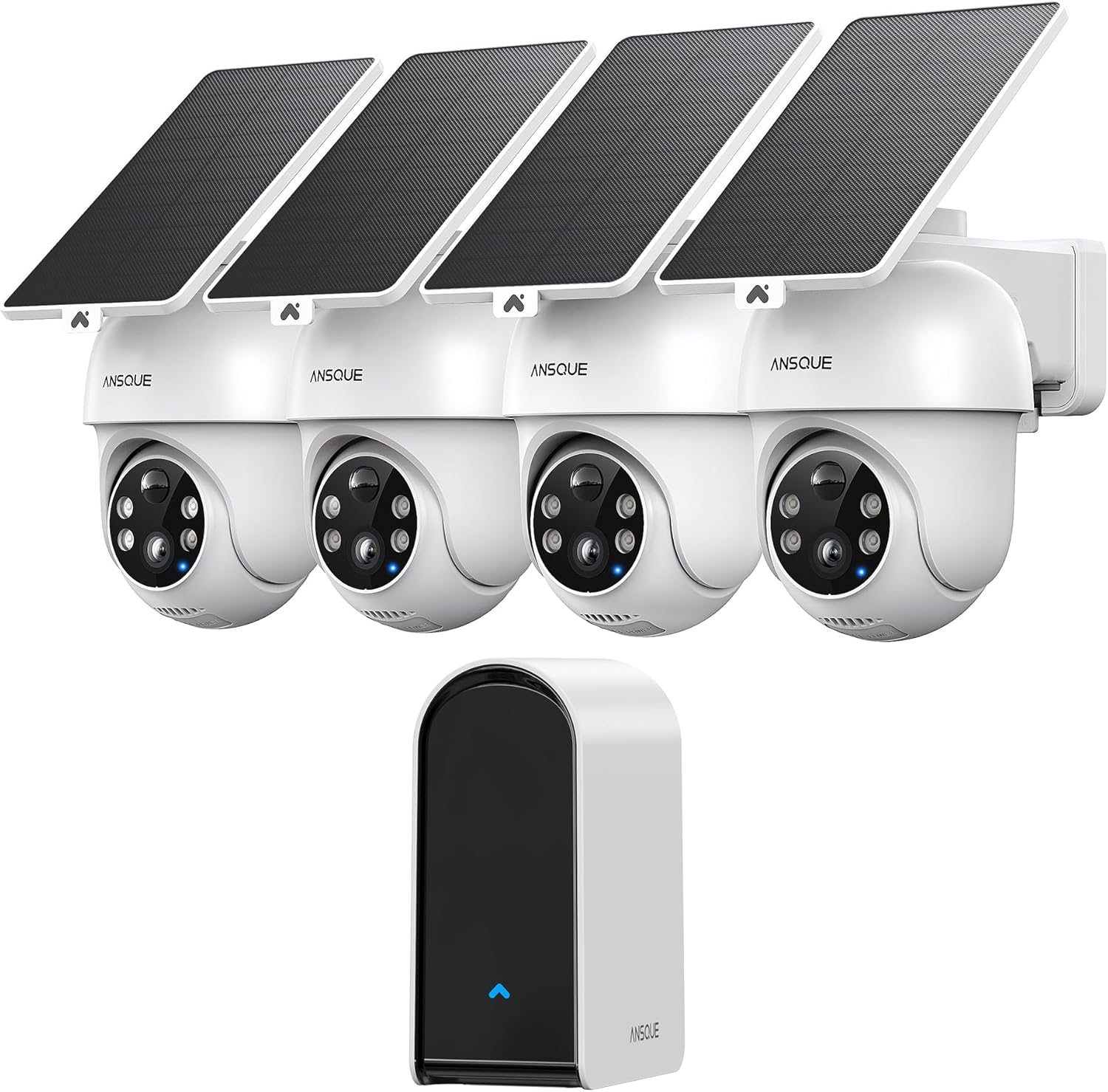 ANSQUE | 2. REOLINK Argus PT Ultra 4K Solar Security Camera REOLINK | 3. eufy Security SoloCam S340 Dual-Lens Solar Camera EUFY | 4. aosu 3K 5MP Solar Security Camera 4-Cam Kit AOSU | 5. aosu D1 Classic 4-Cam Solar Security System AOSU | |
|---|---|---|---|---|---|
| Our Score | 9.6 | 9.4 | 9.2 | 9 | 8.8 |
| Deal | — | — | — | — | — |
| Brand / Store | ANSQUE | REOLINK | eufy Security | aosu | aosu |
| Camera Count | 4 cameras | 1 camera | 1 dual-lens camera | 4 cameras | 4 cameras |
| Resolution | 2K | 4K 8MP | 3K | 3K 5MP | 3MP 2K |
| Coverage | 360-degree PTZ | 355-degree pan / 140-degree tilt | 360-degree pan and tilt | 166-degree fixed view | 360-degree PTZ |
| Night Vision | 2K color | Color | Color | Color spotlight | Color |
| Local Storage | 32GB local | microSD up to 512GB / hub / FTP | 8GB built-in | 32GB local | 32GB local |
| Wi-Fi | 2.4/5GHz | 2.4/5GHz Wi-Fi 6 | Not stated | Not stated | Not stated |
| Subscription | Not required | Not required | Not required | Not required | Not required |

Solar Security Camera Buying Guide
The best solar security cameras reduce wiring and charging maintenance without sacrificing useful home monitoring. When comparing solar security cameras wireless outdoor, focus on reliable sunlight placement, camera resolution, detection accuracy, storage costs and Wi-Fi range rather than choosing by resolution alone.
Choose a Single Camera or Multi-Camera System
A single pan-and-tilt camera works well for a driveway, side yard or porch. A four-camera solar security system is better when you need simultaneous coverage of entrances, a garage and a backyard. Multi-camera bases can also improve event review by linking footage across cameras, but they require a central hub and a suitable location near the router.
Compare 2K, 3K and 4K Video Resolution
Higher resolution can preserve more facial, clothing and vehicle detail, particularly when digitally zooming. A 4K 8MP camera offers the most pixels in this comparison, while 2K and 3K models can still produce useful footage with good lighting and lens quality. Check the live-view and recorded resolution separately because some cameras lower quality to preserve battery or bandwidth.
Solar Panel Placement and Battery Reliability
Solar-powered outdoor security cameras need several hours of useful daylight, but manufacturer sunlight claims are measured under favorable conditions. A detachable panel lets you place the camera under an eave while positioning the panel in direct sun. Shade, winter weather, frequent live viewing, cold temperatures and constant motion events can increase charging demand.
Pan, Tilt, Field of View and Blind Spots
A 360-degree PTZ solar camera can follow motion and inspect different areas, but it only records where the lens is pointed at that moment. A fixed 166-degree ultra-wide camera sees a broad area continuously. For high-risk entrances, overlapping fixed views or a multi-camera kit can be more dependable than relying on one moving lens.
AI Detection and Auto-Tracking
AI person, vehicle and animal detection can reduce alerts from trees and changing light. Auto-tracking helps keep a subject in frame, while cross-camera tracking organizes clips as someone moves around the property. Detection zones, sensitivity settings and notification schedules matter as much as the AI label, so review the app controls before buying.
Night Vision, Spotlights and Deterrence
Color night vision usually needs a spotlight or enough ambient light. Infrared night vision is more discreet but produces monochrome footage. If active deterrence matters, look for a spotlight, siren, two-way audio and fast phone notifications, then position the camera so reflections and nearby walls do not wash out the image.
Local Storage and No-Subscription Security Cameras
Outdoor security cameras without subscription can store footage on a built-in drive, microSD card, local hub or FTP server. Compare storage capacity, encryption, event-loop duration and what happens if the camera is stolen. No required monthly fee does not always mean every AI feature is free, so check whether cloud recording or advanced detection remains optional.
Wi-Fi Range, Privacy and Smart-Home Support
Dual-band Wi-Fi can provide more connection choices, while 2.4GHz typically reaches farther through exterior walls. Confirm whether a hub is required, how recordings are encrypted, whether two-factor authentication is available and how long the manufacturer supplies firmware updates. HomeBase or Home Hub compatibility can simplify larger systems, but ecosystem-specific accessories add cost.
How to Install Solar Security Cameras Wireless Outdoor
- Map entrances and blind spots, then test Wi-Fi signal at each intended mounting point.
- Choose a height that captures faces while keeping the camera difficult to reach or tamper with.
- Aim the solar panel toward reliable direct sunlight and keep it clear of roof shadows, leaves and snow.
- Avoid pointing the lens directly at the sun, reflective walls, busy roads or moving trees that can trigger alerts.
- Set motion zones, detection types, alert schedules, recording length and privacy masks in the app.
- Walk through each detection area during daylight and at night, then review image detail and notification speed.
- Check mounting hardware, battery level, panel cleanliness and firmware periodically.
Best Solar Security Camera FAQ
ANSQUE is the strongest complete four-camera system in this comparison, while REOLINK Argus PT Ultra is the highest-resolution single-camera option. eufy and aosu also provide local-storage choices without a required monthly fee.
They can, because an internal battery stores energy, but charging slows with short days, shade, snow and heavy use. Place the panel in direct sun and monitor battery levels during the least sunny season.
4K preserves more detail for cropping and digital zoom, but uses more storage and bandwidth. A well-positioned 2K camera can be sufficient for a porch or small yard, while 4K is useful for driveways and larger areas.
Most battery-powered solar cameras prioritize motion-event recording to conserve energy. Continuous recording availability depends on the model, storage method, power conditions and app settings.
Manufacturer claims range from minutes to a few hours of direct sunlight per day. Actual needs depend on motion frequency, live viewing, temperature, Wi-Fi quality and recording settings.
They avoid mains power and Ethernet wiring, but still use Wi-Fi or a proprietary wireless connection and may require a hub. The solar panel connects to the camera with a short charging cable on detachable-panel models.
Get weekly top picks
Data-ranked products delivered to your inbox every week. Skip the research, get the winners.
No spam ever. Unsubscribe anytime. We respect your inbox.